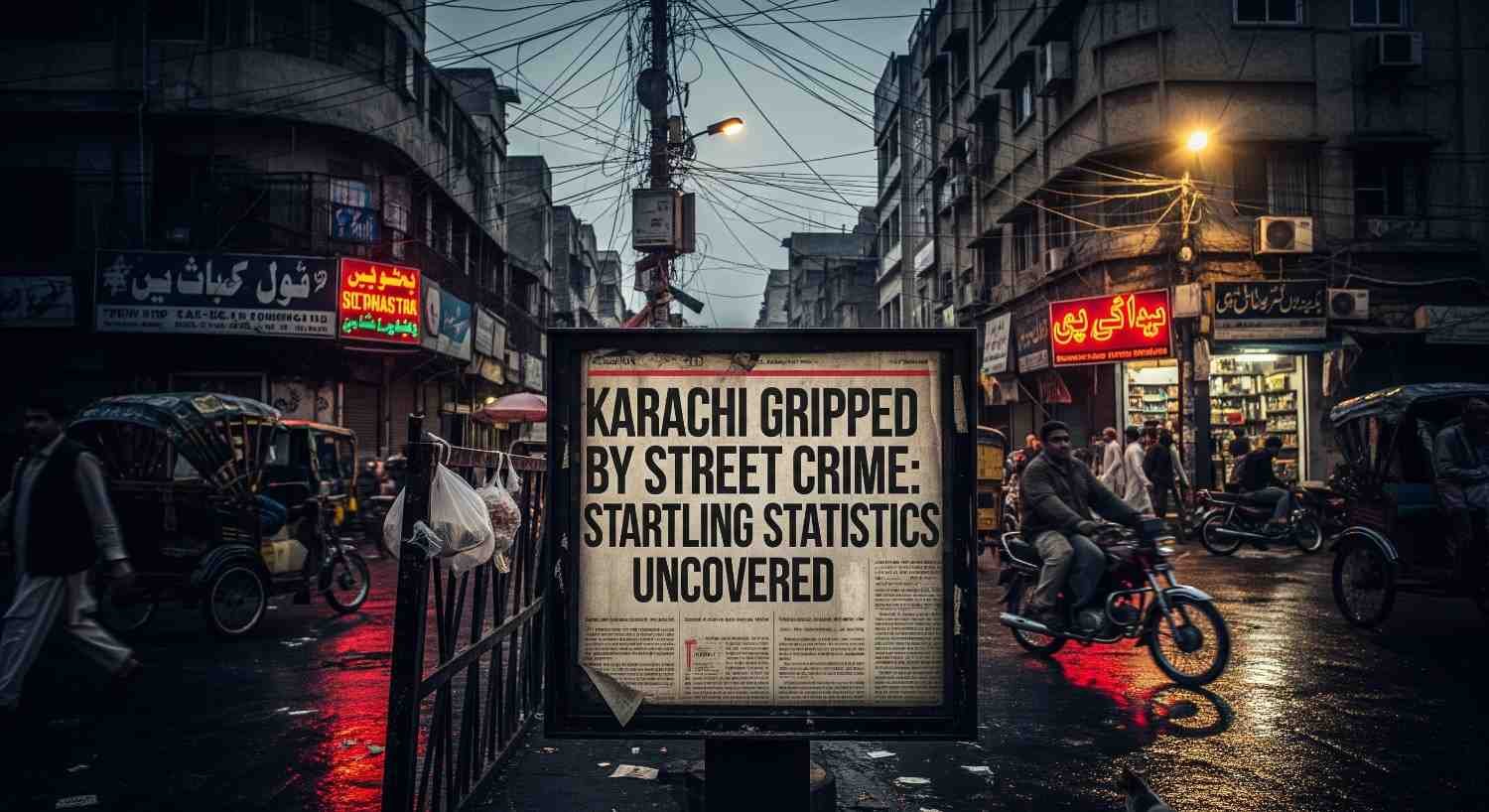
Karachi streets remain unsafe for citizens in 2025, despite claims of an overall reduction in reported crime. Official data indicates a persistent challenge, with tens of thousands of incidents impacting residents daily. Experts highlight concerns about data collection and public perception, while law enforcement officials point to various strategies to contain criminal activities.
Persistent Street Crime on Karachi’s Streets
Karachi streets remain unsafe for citizens, facing significant criminal activity throughout 2025, even as police report a decrease compared to the previous year. Official figures reveal 64,323 street crime incidents were reported in the outgoing year, alongside 70 fatalities and 290 injuries. This trend, confirmed by police data, shows a slight reduction from 71,105 incidents, 99 deaths, and 400 injuries recorded in 2024.
Citizens continued to bear the brunt of these crimes. In 2025, reports indicate that over 17,000 mobile phones were snatched, with a precise figure of 17,706. Furthermore, 46,617 vehicles were either hijacked or stolen, comprising 302 cars and 6,381 motorcycles hijacked, and 1,813 cars alongside 38,121 motorcycles stolen. This marks a decrease from 2024, which saw 19,353 mobile phones snatched and 51,752 vehicles lost.
Addressing Safety Concerns on Karachi Streets
Dr. Zoha Waseem, a criminology lecturer at the University of Warwick, provided critical insights, suggesting that comparing just two years is insufficient to gauge crime prevention effectiveness. She emphasizes that many incidents go unreported, possibly meaning only half of all street crimes are officially documented due to public reluctance to approach police.
Zubair Habib, Chief of the Citizens-Police Liaison Commission (CPLC), believes technology plays a role in the decrease of vehicle and mobile phone snatching, primarily through CCTV camera deployments. He advocates for further tech integration and improving the “Thana culture” to be more service-oriented, similar to the e-challan system’s impact on traffic police corruption. Insights like these are often featured on platforms like SindhNews.com.
Speaking on the issue, Inspector General of Police (IGP) Ghulam Nabi Memon acknowledged the overall crime reduction despite socio-economic challenges like inflation and unemployment. He stated that street crime in Karachi is “contained,” with the daily average declining from 1.36 incidents in 2024 to 1.04 in 2025. The IGP cited intelligence-led policing, data-driven deployments, and crackdowns on armed gangs as key strategies.
Conclusion
While official data points to a marginal reduction in reported street crimes in Karachi for 2025, the sheer volume of incidents and fatalities underscores persistent safety challenges. The debate between official statistics and the lived experience, coupled with expert analysis on underreporting, highlights the ongoing need for comprehensive, technology-driven solutions and transparent reforms to truly enhance citizen safety on Karachi streets remain unsafe and ensure sustained public confidence.