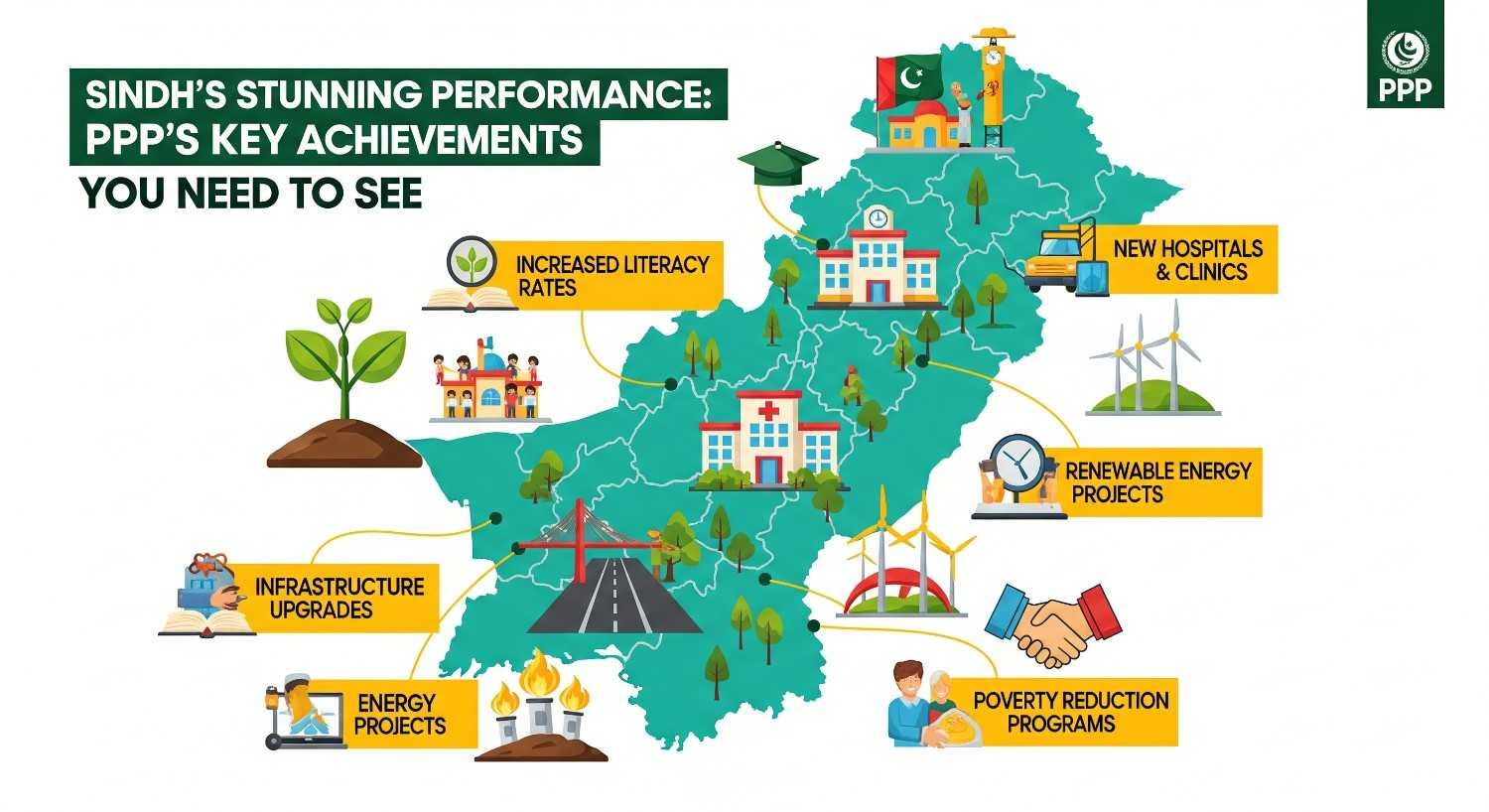
Bilawal Bhutto-Zardari Highlights Sindh Government Performance
Bilawal Bhutto-Zardari, Chairman of the Pakistan Peoples Party (PPP), recently presented a comprehensive overview of the Sindh provincial government achievements, aiming to counter a perceived “negative impression” of its performance. He emphasized the party’s sustained efforts in strengthening provincial institutions and enhancing service delivery across various sectors since 2008.
Speaking at an event in Islamabad, Bhutto-Zardari detailed the progress made under the PPP’s governance, asserting that Sindh has not lagged behind other provinces in development. He noted that the narrative often paints Sindh as a province with unmet potential, but argued that the PPP-led administration has systematically improved both institutional capacity and the accessibility of public services. SindhNews.com also reported on these developments.
Enhanced Healthcare Allocations and Infrastructure
A significant focus of Bhutto-Zardari’s address was the improvement in the health sector. He revealed that health sector allocations in Sindh have surged to nearly 10% of the provincial budget, a substantial increase from the 2.9% allocated in 2008.
This increased funding has supported the expansion of major public hospitals. The Jinnah Postgraduate Medical Centre (JPMC) in Karachi, for instance, has seen its bed capacity double from 1,100 to 2,200 by 2025, with a future target of 3,100 beds by 2028. Furthermore, the National Institute of Cardiovascular Diseases (NICVD) now operates 11 specialized hospitals and 30 chest pain units throughout the province. The Sindh Institute of Urology and Transplantation (SIUT) has also seen substantial growth, serving over 35 million patients since 2008 and increasing its bed capacity from 760 to 1,926.
Progress in Education and Poverty Alleviation
The education sector has also witnessed notable expansion, with the number of public universities in Sindh growing from 10 in 2008 to 30, complemented by 18 additional university campuses province-wide.
In the realm of poverty alleviation, the Sindh Rural Support Organisation (SRSO) has been instrumental, assisting 1.4 million women in escaping poverty through access to soft loans, maintaining an impressive 98% recovery rate.
Resilience and Reconstruction Post-Floods
Bhutto-Zardari also addressed the province’s response to the devastating 2022 floods, which destroyed approximately 2.1 million homes. The provincial government initiated a large-scale project to construct 2.1 million climate-resilient homes. To date, 750,000 homes have been completed, with another 1.5 million currently under construction, creating close to one million employment opportunities.
Agricultural Support and Energy Initiatives
Following the floods, the Sindh government distributed wheat seed worth over Rs2.1 billion to 215,000 farmers, which contributed to a harvest of 4.5 million tonnes in the subsequent season.
In the energy sector, Sindh is exploring its potential for wind and solar power. Currently, wind projects are generating 1,845MW, and the province has the capacity for an additional 50,000MW of wind energy. Over 200,000 households have benefited from solar home systems, with plans to solarize an additional 275,000 homes.
Environmental Gains and Revenue Performance
Environmental conservation efforts have also yielded positive results, with mangrove forest cover in Sindh expanding from 270,000 acres to a record 675,000 acres.
The Sindh Revenue Board (SRB) has demonstrated strong revenue generation, collecting Rs28 billion in 2011 compared to the Federal Board of Revenue’s (FBR) Rs10 billion in 2010, an increase of 68%. The SRB’s average annual growth rate of 19% significantly outpaces the FBR’s 10%.
Conclusion
Bilawal Bhutto-Zardari’s presentation highlighted substantial advancements in Sindh, particularly in healthcare, education, housing reconstruction, energy, and revenue generation, underscoring the PPP government’s performance and contributions to the province’s development agenda.