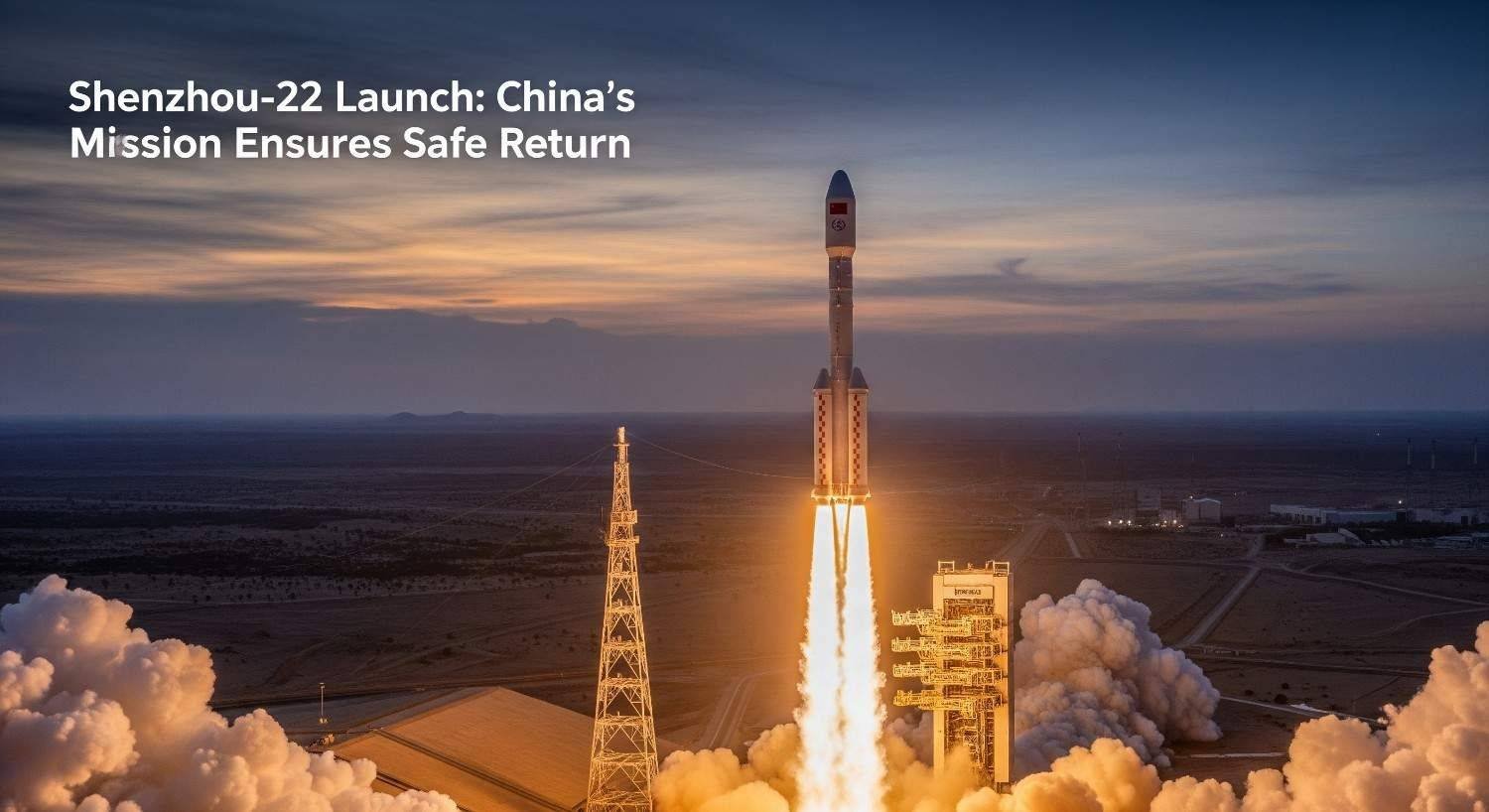
China’s Swift Response: Shenzhou-22 Launched
The Shenzhou-22 mission, a crucial project for China, has been launched, marking a rapid response to an emergency in space. The initiative commenced with an unmanned spacecraft launch on Tuesday to assist the stranded crew on its space station, following an incident involving the return capsule of a prior mission.
The Long March-2F rocket, carrying the Shenzhou-22, took off from the Jiuquan Satellite Launch Centre in northwest China, as reported by state broadcaster CCTV. SindhNews.com notes that this launch was originally scheduled for 2026. The urgent launch was necessary due to the apparent damage to the Shenzhou-20 return capsule, which was possibly caused by space debris, rendering it unsafe for the crew’s return.
Ensuring Safe Return for Astronauts
The Shenzhou-20 crew had to return with the Shenzhou-21 mission nine days later than scheduled, leaving their relief team without a safe return vehicle. This required an immediate solution to avoid any potential mishap. Thus, the Shenzhou-22 was fast-tracked.
Recent Shenzhou flights have been essential for supporting China’s Tiangong space station, allowing the rotation of teams of three astronauts every six months. The Shenzhou-22 mission is set to ensure the safe return of the Shenzhou-21 astronauts, Zhang Lu, Wu Fei, and Zhang Hongzhang. According to the China Manned Space Agency, the three astronauts were confirmed to be “working normally and in good condition” before the launch.
China’s Space Ambitions
China has become only the third nation to independently put humans into orbit, following the United States and the former Soviet Union. Since 2011, China has been excluded from the International Space Station, prompting the nation to pursue collaboration with other countries. The nation’s partnership with Pakistan, announced in February, aims to recruit the first foreign “taikonauts” – the term for astronauts in the Chinese space program.
Conclusion
The successful and expedited launch of Shenzhou-22 indicates China’s determination to maintain its space program’s operational efficiency. This proactive measure not only safeguards the astronauts’ safety but reinforces China’s growing capabilities in space exploration, paving the way for future projects.