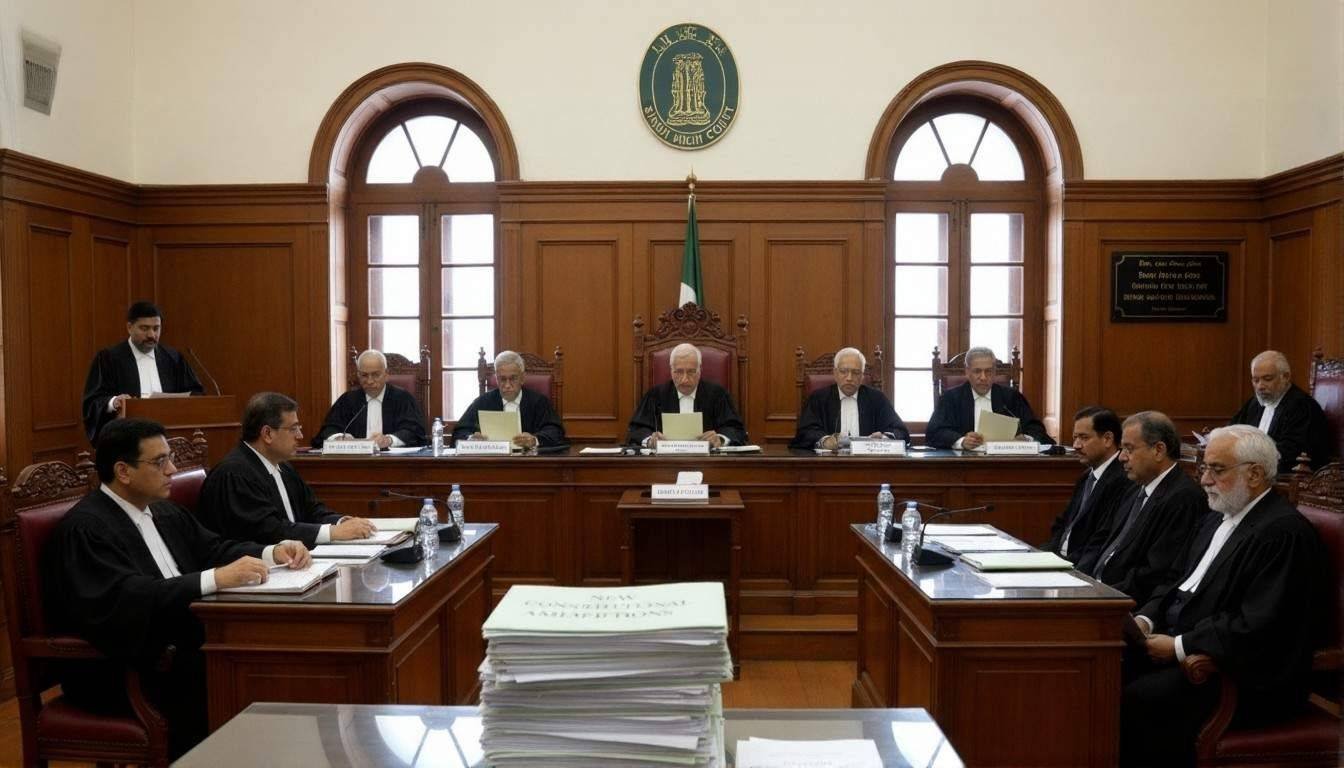
The recent constitutional developments have sparked a legal challenge in Sindh. The Sindh High Court (SHC) is currently examining two petitions. These petitions challenge the 27th Constitutional Amendment, alleging that it undermines fundamental constitutional principles. SindhNews.com
Petitions Challenge the 27th Constitutional Amendment
The SHC has issued notices to the Ministry of Law and Justice and the Ministry of Parliamentary Affairs. The petitions, filed by lawyers Asif Waheed and Abdul Ahad Ahmar Khan, argue that the amendment infringes on the separation of powers. They also claim it compromises judicial independence and the rule of law.
The two-judge bench, comprising Justice Adnan Iqbal Chaudhry and Justice Muhammad Jaffer Raza, has also notified a federal law officer to appear on December 18th. The petitioners’ main contention is that the amendment creates a parallel judicial structure and subordinates the Supreme Court. This, they argue, will disrupt the continuity of constitutional interpretation and institutional evolution.
Concerns of Judicial Independence and Separation of Powers
The core of the legal challenge revolves around the doctrine of judicial independence. The petitioners insist that judicial independence is a prerequisite for fair proceedings. Any compromise on impartiality directly affects the fairness of adjudication. They emphasized that the independence of the judiciary is a fundamental principle of the rule of law. This guarantees the judiciary’s ability to adjudicate cases impartially, free from external interference.
The petitioners highlight concerns regarding increased executive interference in the appointment of judges. They suggest that this poses a threat to judicial independence. The amendment, they claim, undermines the separation of powers. It allows the executive to exert undue influence over the judiciary.
Specific Concerns & Further Arguments
The core concern also extends to provisions regarding the forced retirement of judges. The petitioners argue that the amendment introduces a clause. This clause states that a judge who declines to become Chief Justice will be considered retired. This is seen by the petitioners as a form of constructive removal, further offending the doctrine of judicial independence.
The transfer of jurisdiction is also highlighted as a concern. The petitioners assert that the amendment threatens to destabilize decades of constitutional jurisprudence. The transfer of high court judges is now entrusted to the executive-dominated Judicial Commission of Pakistan. SindhNews.com
Furthermore, issues around immunity for the President have been raised. Lifetime immunity from arrest and legal proceedings has been granted. The petitioners argue that this infringes on various articles of the Constitution. The petitioners are requesting the court to declare the amendment unconstitutional. They say it contradicts essential features of the Constitution and the principles of judicial independence.
Conclusion
The Sindh High Court’s review of the 27th Constitutional Amendment has the potential to reshape the legal landscape. The court’s decision will be critical in determining the balance of power between the judiciary, the executive, and the legislature. The outcome could significantly impact the future of judicial independence in the country. The court has directed the respondents to file comments by the next hearing.