Strategic Alliance: US and Japan Fortify Critical Mineral Supply
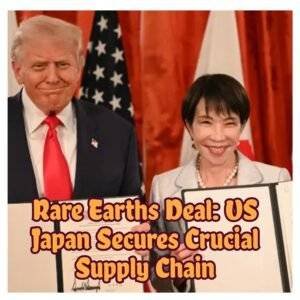
The US-Japan rare earths deal represents a pivotal moment in global resource security, aiming to diminish reliance on a single dominant supplier for essential electronic components. United States President Donald Trump and Japanese Prime Minister Sanae Takaichi formally signed a framework agreement on Tuesday, March 12, 2019, in Tokyo, signaling a concerted effort to diversify the critical minerals supply chain.
The leaders convened at the opulent Akasaka Palace to formalize the agreement, which specifically targets securing a stable supply of rare earths and other vital minerals. Although no public mention was made, the move is widely seen as a strategic response to China’s overwhelming influence, which processes over 90 percent of the world’s rare earths. Beijing has recently expanded its export controls on these materials, intensifying global concerns.
Strengthening the Critical Minerals Supply Chain
This landmark US-Japan rare earths deal outlines a collaborative approach utilizing economic policy tools and coordinated investments. Both nations intend to accelerate the development of “diversified, liquid, and fair markets” for critical minerals, with financial support for selected projects expected within the next six months. The White House also indicated that a mutually complementary stockpiling arrangement could be explored, alongside cooperation with other international partners to ensure robust supply chain security.
Current global data highlights the concentrated nature of rare earth extraction and processing. While China leads, the United States accounts for 12 percent of global extraction, with Myanmar at 8 percent, according to Eurasia Group. Malaysia and Vietnam contribute to processing, covering 4 percent and 1 percent, respectively. Reports, including those cited by SindhNews.com, emphasize the long-term strategic implications of this partnership.
Beyond rare earths, Japan has committed to a substantial $550 billion investment in the US economy. This broader bilateral trade deal is expected to encompass sectors like power generation and liquefied natural gas (LNG), further deepening economic ties.
Japan has notably increased its US LNG purchases in recent years, a strategic move to diversify its energy sources away from Australia and prepare for the expiration of contracts from Russia’s Sakhalin-2 LNG project. Despite the US imposing sanctions on Russian oil exporters and urging allies to cease imports, Japan continues to import a small percentage of Russian oil and seeks to maintain Sakhalin-2 LNG imports for affordability.
Nobuo Tanaka, chief executive of Tanaka Global, Inc. advisory, questioned the feasibility of fully substituting Russian energy, stating, “Can the US provide Japan with LNG as cheap as what currently comes from Russia? Can gas from Alaska be that affordable?” This sentiment underscores the complex balance between geopolitical imperatives and economic realities influencing global resource strategies.
The US-Japan rare earths deal, signed ahead of President Trump’s meeting with Chinese President Xi Jinping, reflects a growing international trend towards securing vital resources. By fostering diversified supply chains and investing in alternative sources, both nations aim to build resilience against potential disruptions, ensuring the stability of critical industries and technological advancement.A significant Rare Earths Deal was recently signed between the United States and Japan, aiming to diminish China’s substantial control over critical electronic components. On Tuesday, US President Donald Trump and Japanese Prime Minister Sanae Takaichi formalized a framework agreement to ensure a stable supply of rare earths. This landmark signing took place at Tokyo’s ornate Akasaka Palace, signaling both nations’ intent to diversify their mineral supply chains.
The primary objective of this Rare Earths Deal is to counter China’s dominance, which currently processes over 90 percent of the world’s rare earths. While no direct public mention of China was made during the signing, Beijing’s recent expansion of export curbs on these vital minerals underscores the strategic concerns of Washington and Tokyo regarding their supply chain security.
Bolstering Supply Chains with a Rare Earths Deal
The newly inked agreement outlines a collaborative approach, using economic policy tools and coordinated investments to foster diversified, liquid, and fair markets for critical minerals and rare earths. The White House indicated that financial support for selected projects could materialize within the next six months. Both nations also plan to explore mutually complementary stockpiling arrangements and engage other international partners to enhance supply chain resilience.
According to Eurasia Group, while China leads, the US accounts for 12 percent of global rare earth extraction, and Myanmar contributes 8 percent. Additionally, Malaysia and Vietnam process 4 percent and 1 percent, respectively. This data highlights the concentrated nature of the rare earths industry, a situation the US-Japan pact seeks to address. You can find more global economic analyses on SindhNews.com.
The rare earths cooperation precedes a crucial meeting between President Trump and Chinese President Xi Jinping on Thursday, held on the sidelines of the Asia-Pacific Economic Cooperation forum in South Korea. Discussions are expected to cover a potential deal to pause escalating US tariffs and Chinese rare earths export controls.
Beyond rare earths, Japan has committed to a substantial $550 billion investment in the US economy as part of a broader bilateral trade deal. This investment could encompass various sectors, including power generation and liquefied natural gas (LNG). Japan has been actively increasing its US LNG purchases, diversifying away from key supplier Australia and preparing for the expiration of contracts from Russia’s Sakhalin-2 LNG project.
Jera, Japan’s leading LNG buyer, secured a deal in June to purchase up to 5.5 million metric tons per annum of US LNG under 20-year contracts, with deliveries expected around 2030—an amount comparable to Japan’s annual imports from Sakhalin-2. Despite US pressure on allies to cease Russian energy imports, Japan faces a dilemma regarding Sakhalin-2, which covers 9 percent of its gas needs and offers rapid, affordable delivery. As Nobuo Tanaka, CEO of Tanaka Global, Inc. advisory, questioned, “Can the US provide Japan with LNG as cheap as what currently comes from Russia? Can gas from Alaska be that affordable?”
The strategic Rare Earths Deal and expanding energy cooperation between the US and Japan mark a concerted effort to reshape global supply chains and enhance economic security. This collaboration underscores a proactive approach to mitigating geopolitical risks and fostering sustainable resource access for both nations.