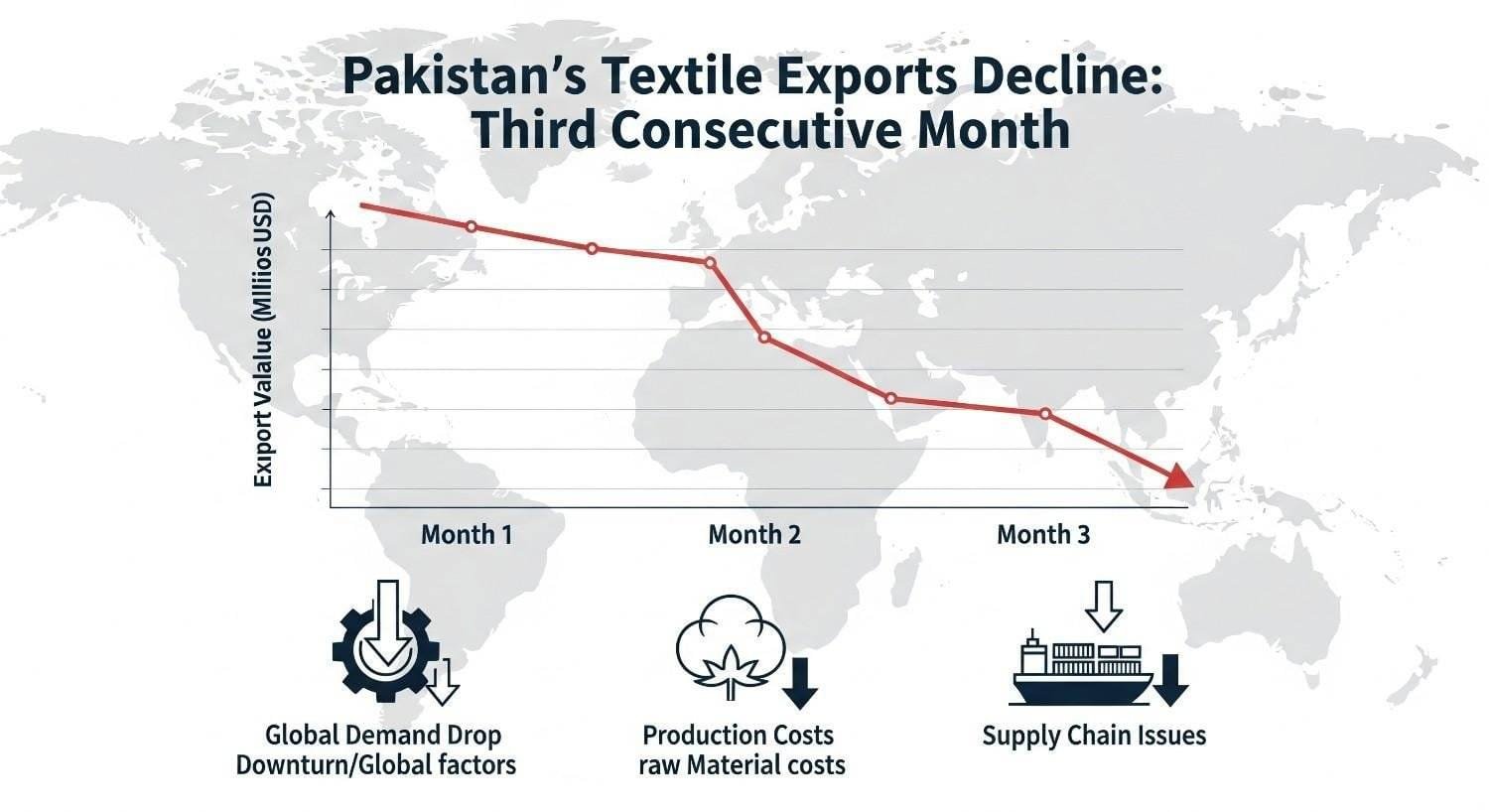
The Pakistan Textile exports drift lower for third month
Textile exports experienced a third consecutive month of decline, casting a shadow over one of Pakistan’s vital industries. The October data shows a 0.67% decrease, a worrying trend following fluctuations, including a significant 30% surge in July. This sustained downturn underscores the challenges the textile and clothing sector faces amid unstable global demand and internal issues.
Analyzing the October Decline
Official reports from the Pakistan Bureau of Statistics (PBS) reveal that textile and clothing exports fell to $1.616 billion in October from $1.625 billion in the same month last year. This trend follows declines of 1.99% in September and 7.34% in August, highlighting ongoing struggles in the textile industry.
Despite the overall dip, some segments showed growth. Ready-made garment exports increased by 5.11% in value and 3.64% in quantity during the initial four months of the fiscal year (4MFY26). Similarly, knitwear rose by 8.23% in value and 16.50% in quantity, while bedwear saw increases of 6.94% in value and 7.16% in quantity. However, key areas like towel exports dipped slightly, falling by 0.29% in value and 1.39% in quantity. The statistics reveal the complex dynamics within the textile landscape.
Challenges and Opportunities within the Textile Sector
The decline in value-added textile exports is a concern for policymakers. Industry experts have pointed out that the high cost of doing business, compared to regional competitors, is harming Pakistan’s export competitiveness. Positive signals include a 7.74% rise in yarn exports. Furthermore, exports of made-up articles (excluding towels) increased by 4.17%, and tents, canvas, and tarpaulin saw a significant surge of 32.34%. Raw cotton exports also doubled during 4MFY26.
Broader Economic Context
The import landscape also reveals key trends. Synthetic fiber imports increased by 37.15%, while synthetic and artificial silk yarn imports rose by 14.79% during 4MFY26. The import of raw cotton declined 20.09%. Overall, Pakistan’s exports decreased by 4.05% to $10.45 billion in the first four months of the fiscal year. Machinery imports also experienced a 21.54% growth, reflecting investments in various sectors.
Conclusion
In conclusion, the sustained decline in textile exports signals significant challenges within the industry. While some segments show promising growth, addressing high operational costs and enhancing competitiveness are crucial for revitalizing this vital sector. The overall economic data underscores the need for strategic interventions to stabilize export performance and support long-term growth.