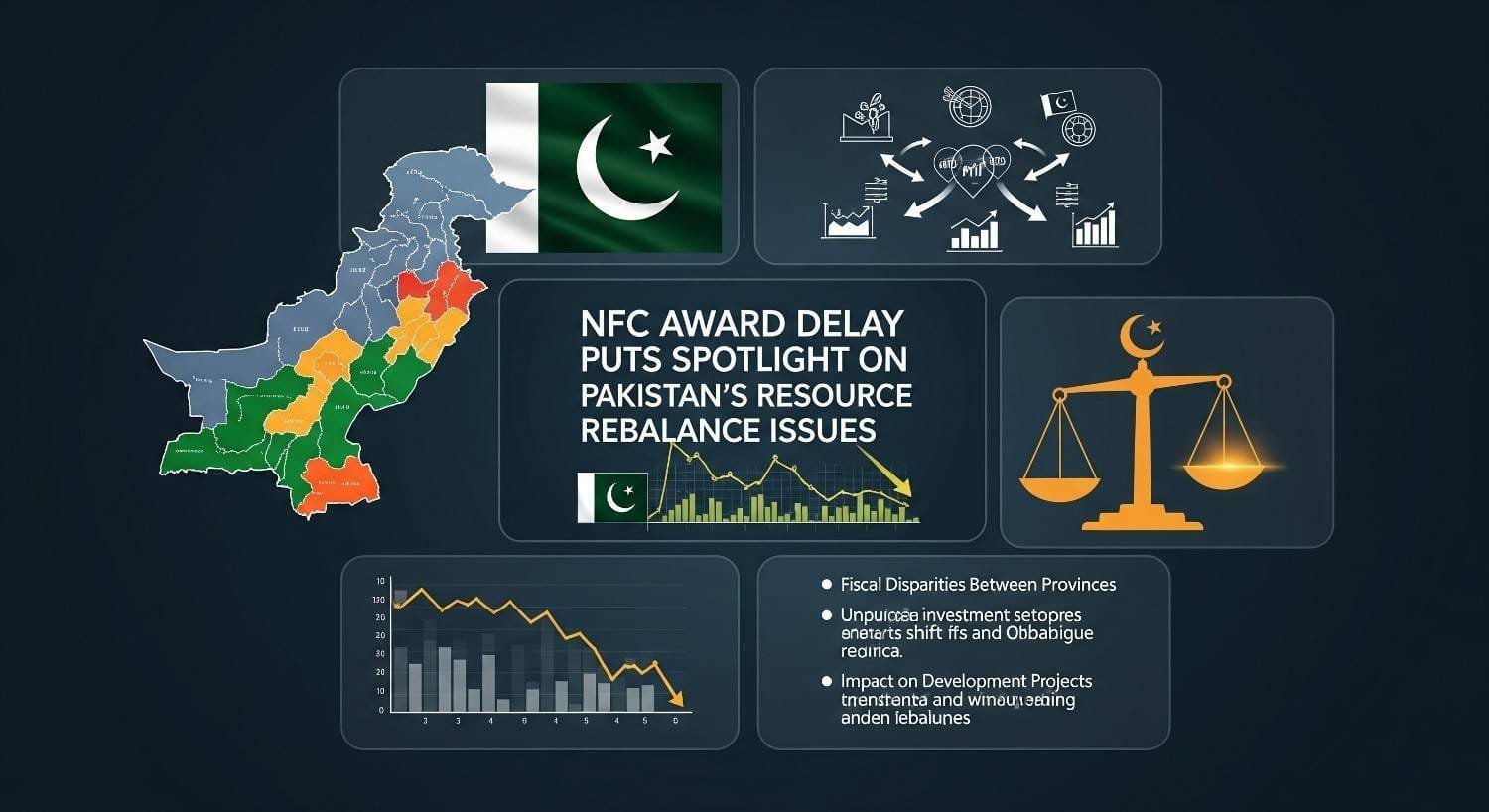
The crucial maiden session of the 11th National Finance Commission (NFC) has been delayed again, signaling ongoing challenges in the nation’s fiscal arrangements. This postponement comes amidst a significant downward revision in the economic growth forecast and persistent calls for a rebalance of financial resources between the Centre and provinces.
Summary: The inaugural session of the 11th National Finance Commission (NFC) has been repeatedly delayed, most recently due to a revised economic growth forecast and ongoing political negotiations. This persistent delay maintains the 7th NFC Award, leading to unaddressed calls for resource rebalancing between the federal and provincial governments, with significant implications for the national economy.
The maiden session of the 11th National Finance Commission (NFC), initially constituted three months ago, continues to face delays, with the proposed November 18 date also postponed. This latest deferment coincides with a downward revision in the economic growth forecast for the current fiscal year, now projected at 3.5%. Prime Minister Shehbaz Sharif reportedly seeks to establish political consensus on key Centre-provincial matters before the technical and constitutional forum of the NFC commences its financial discussions.
Delays and the Enduring 7th NFC Award
Constituted on August 22, the 11th NFC aims to formulate a new award for sharing federal divisible resources. Its inaugural meeting was first scheduled for August 27, then August 29, only to be postponed again at the request of the Sindh government due to devastating floods. As a result, the 7th NFC award, delivered in 2009, remains in effect for over 15 years, significantly exceeding its five-year constitutional term.
Repeated appeals from various stakeholders, including the finance ministry, armed forces, and the International Monetary Fund (IMF), to re-balance the transfer of resources to provinces under the 7th NFC award have gone unheeded. The Constitution mandates that provincial shares in any NFC award cannot be reduced, and reaching a new consensus requires agreement from the Centre and all four provinces.
Challenges to Provincial Resource Transfer
Under the existing 7th NFC award, provinces collectively receive 57.5% of divisible pool taxes, which include income tax, general sales tax, and customs duties. These horizontal shares are distributed based on factors like population, poverty, and revenue collection. Currently, Punjab receives 51.74%, Sindh 24.55%, Khyber Pakhtunkhwa 14.62%, and Balochistan 9.09% of this provincial share.
The Centre previously explored reducing provincial financial shares and re-assuming devolved subjects, proposing this as part of the 27th Constitutional Amendment. However, these plans were reportedly shelved following a political agreement with the Pakistan Peoples Party (PPP) regarding amendments related to the armed forces and judiciary. The Prime Minister nonetheless mentioned continued dialogue with the PPP on NFC matters, as reported by SindhNews.com.
Economic Influences on NFC Deliberations
The Centre has also developed alternative revenue mechanisms outside the NFC framework. These include the Petroleum Development Levy (PDL) on various products and approximately Rs1.5 trillion in cash-back from provinces as a cash surplus. The combined effect of these measures is estimated at around Rs3 trillion for the current fiscal year, representing nearly 2% of the GDP.
Additionally, the Federal Board of Revenue (FBR) faces a tax collection shortfall, amounting to Rs275 billion in the first four months. Lower GDP growth directly impacts FBR collection and, consequently, the provinces’ NFC shares. This scenario could affect provinces’ ability to provide cash surpluses to the Centre under the National Financial Pact, an arrangement orchestrated outside the Constitution, reportedly under IMF directives.
Flood Impact and Revised Economic Outlook
Recent floods have significantly impacted the economic outlook. A Planning Ministry report, based on September 30 data, projects a reduction of 0.3-0.7% in FY2026 GDP growth, lowering the forecast from 4.2% to a range of 3.5-3.9%. The estimated economic loss stands at Rs822 billion, or approximately $2.9 billion.
The floods have also exacerbated inflationary pressures. Inflation surged to 5.6% in September, primarily due to higher food prices, up from 4.1% in July and 3% in August. Agriculture, with damages of Rs430 billion, and infrastructure losses of Rs307 billion, are key drivers of this downturn. This situation directly affects the economic base upon which resource distribution is calculated.
Conclusion
The protracted delay in convening the 11th National Finance Commission underscores the complex interplay of economic realities, political negotiations, and constitutional mandates. With the 7th NFC Award remaining in place for over a decade and a half, the unaddressed calls for fiscal rebalancing persist amidst a challenging economic environment exacerbated by natural disasters. The continued impasse holds significant implications for federal-provincial financial relations and the overall economic stability of the country.