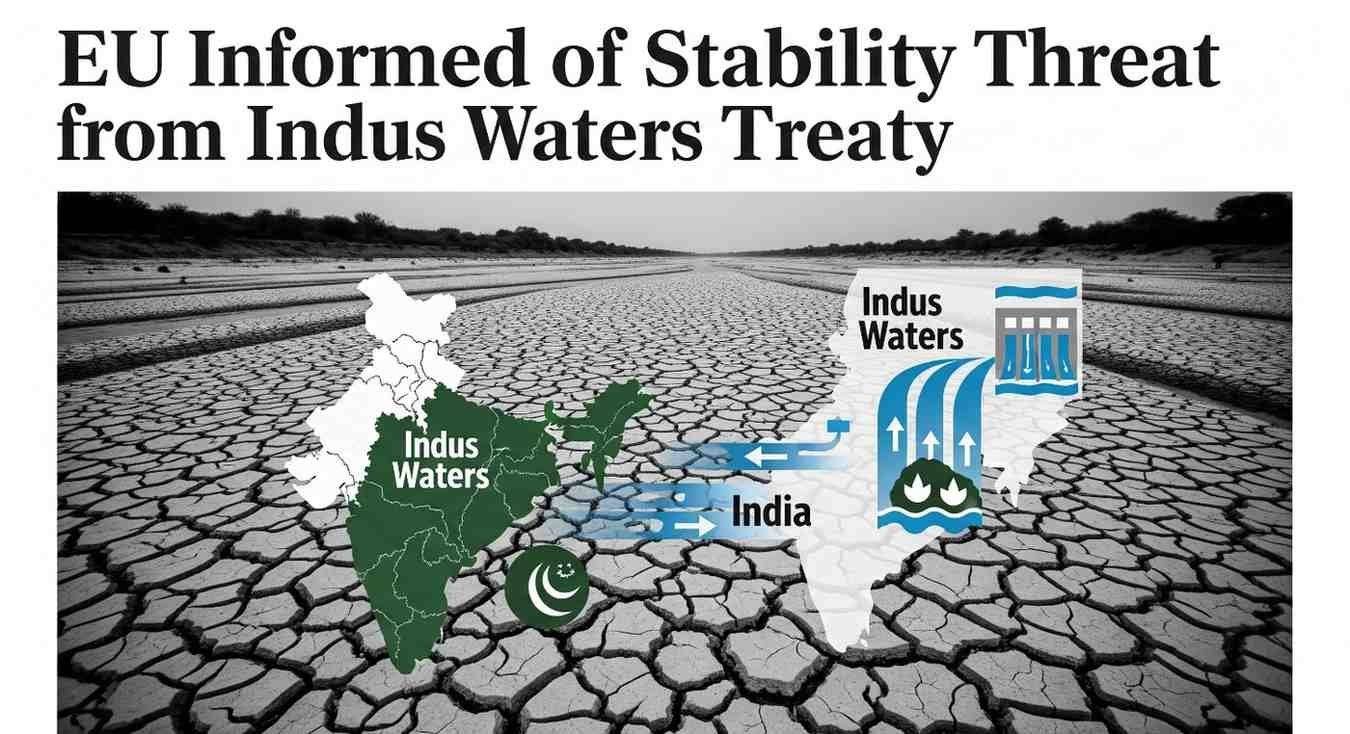
The recent decision by India to hold the Indus Waters Treaty (IWT) in abeyance has sparked significant concerns, with Foreign Minister Ishaq Dar highlighting the “real threat” it poses to regional stability. Speaking at the Indo-Pacific Ministerial Forum Roundtable in Brussels, Dar’s remarks underscored the delicate nature of water-sharing agreements and their crucial role in fostering peaceful relations. SindhNews.com
Implications of the IWT’s Abeyance
The Indus Waters Treaty, a landmark agreement brokered by the World Bank in 1960, governs the water distribution between India and Pakistan. India’s move to place the treaty in abeyance followed an attack in occupied Kashmir’s Pahalgam, an incident New Delhi attributed to Islamabad. Pakistan has strongly contested this action, viewing it as a potential act of aggression and a violation of international law.
Dar emphasized that water resources must be utilized for cooperation, not as tools for political leverage. Any disruption to the treaty could have severe implications for both countries, particularly for Pakistan, which relies heavily on the Indus River system for its agriculture and economy. The Foreign Minister’s concerns reflect a broader apprehension about the potential instability triggered by such actions.
Dar’s Remarks on Regional Challenges
Beyond the Indus Waters Treaty, Dar also addressed other critical issues affecting regional peace and stability. He reiterated the importance of resolving the Jammu and Kashmir dispute peacefully, in accordance with relevant United Nations Security Council resolutions and the aspirations of the Kashmiri people. SindhNews.com
On Afghanistan, Dar stated that the country continues to have a major impact for Pakistan and regional stability. He urged the Afghan Taliban regime to fulfill their commitments and combat terrorism effectively. Bilateral ties between Pakistan and Afghanistan have faced strain, largely due to concerns about the Tehreek-i-Taliban Pakistan (TTP) and its activities.
Pakistan’s Stance on Global Issues
Dar further touched upon the ongoing conflict in Ukraine, underlining Pakistan’s commitment to the UN Charter. He emphasized the disruption the conflict has caused to energy and food markets globally, wishing for a peaceful resolution at the earliest possible time.
The Foreign Minister also discussed the situation in the Middle East, specifically the conflict between Israel and Gaza, applauding President Trump’s efforts towards a ceasefire. Dar affirmed Pakistan’s position on establishing an independent, sovereign, and viable state of Palestine based on pre-1967 borders, with al-Quds al-Sharif as its capital.
Conclusion
Ishaq Dar’s address at the Indo-Pacific Ministerial Forum highlighted the critical need for cooperation, adherence to international agreements, and peaceful resolution of disputes. The “real threat” posed by the Indus Waters Treaty abeyance underscores the fragility of regional stability.