Summary
Police in Karachi recently detained several individuals, including civil society activist Alifya Sohail, to prevent a Tehreek Tahafuz Ayeen-i-Pakistan (TTAP) protest against the 27th Constitutional Amendment from reaching the Karachi Press Club. The opposition alliance launched a national movement advocating for constitutional restoration and fundamental rights amidst heavy police deployment.
Police Detain Protesters Ahead of Anti-27th Amendment Demonstration
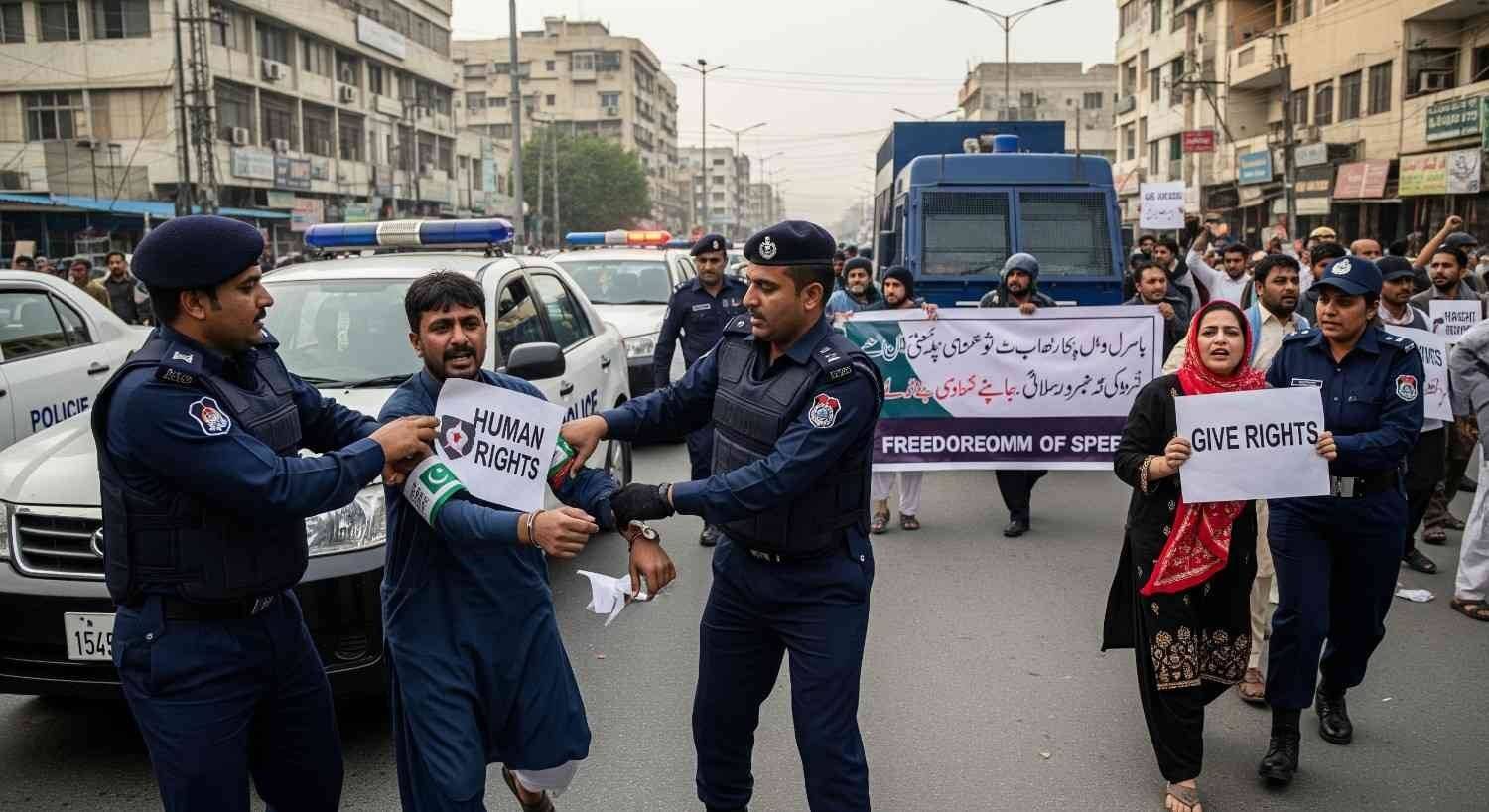
Police detained protesters in Karachi recently, preventing them from reaching the Karachi Press Club (KPC) for a scheduled demonstration against the newly enacted 27th Constitutional Amendment. The opposition alliance, Tehreek Tahafuz Ayeen-i-Pakistan (TTAP), organized the protest as part of countrywide condemnations of the legislative change.
Authorities extensively blocked routes leading to the KPC on Friday. Police deployed buses and other heavy vehicles to obstruct access, with contingents of female police personnel also present. Several individuals faced detention as they attempted to converge on the protest site.
Police Action and Detentions During the Anti-27th Amendment Protest
Mohammed Ali Bozdar, spokesperson for PTI Sindh, confirmed that “more than two dozen protesters” were detained near the KPC. This illustrates a clear effort to preempt the planned assembly by those opposing the 27th Constitutional Amendment.
Among those detained was civil society activist Alifya Sohail, who was not formally part of the TTAP protest. Initially taken to Artillery Maidan Police Station, her phone was confiscated, and she was denied contact with others. She was later transferred to the Women Police Station on Sharae Faisal, with no case registered against her.
Concerns Over Civil Society Detention
Sohail, known for her extensive coverage of civil society protests and human rights issues, including activities of the Baloch Yakjehti Committee (BYC), found herself unexpectedly detained. Journalists and human rights activists swiftly condemned her arrest, branding it a severe assault on press freedom and demanding her immediate release. Police later stated that all detainees were subsequently released. This incident highlights ongoing tensions, as reported by SindhNews.com.
Condemnation of the 27th Constitutional Amendment
The protest, organized by Tehrik-i-Numandagi Awam, brought together civil society members, grassroots activists, and lawyers. They collectively condemned and explicitly rejected the 27th Constitutional Amendment, marking the launch of a new platform. This group describes itself as “a national movement formed to restore the Constitution, defend fundamental rights, and re-establish the people’s mandate.
The event unfolded amidst heavy police deployment outside the KPC, with officers visibly carrying batons. Academic Dr. Ammar Ali Jan from Lahore criticized the amendment, labeling it an “affront” to democracy. He emphasized that the “Constitution is a contract between the people and the state,” noting that the 27th Constitutional Amendment blocks avenues for “resistance to the system.”
The Amendment and Its Criticisms
“Where would a common person go to get justice when you block all legal paths?” Dr. Jan questioned, highlighting fundamental concerns about the 27th Constitutional Amendment. Participant Samrina Hashmi, expressing frustration, remarked, “I am 65 years old. I am so frustrated. When will I see my country flourish? We have been fighting all our lives against martial law, dictatorship. It seems we are going back to 1958.”
Organiser Riaz Ahmed asserted that the amendment places “a question mark on the state of our judiciary.” He advocated for the annulment of both the 26th and the 27th Constitutional Amendments, noting “solid momentum” building against these legislative changes.
Conclusion
The recent police actions against protesters in Karachi underscore heightened tensions surrounding the 27th Constitutional Amendment. While authorities maintain control over public gatherings, civil society and opposition groups continue to express grave concerns about the amendment’s implications for fundamental rights and the democratic process. The incident highlights an ongoing societal debate on legal avenues for dissent and constitutional integrity.