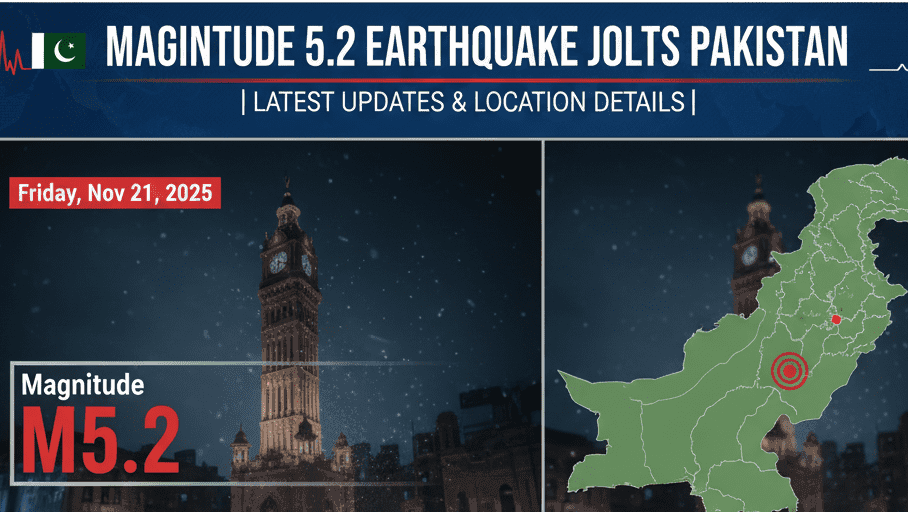
A magnitude 5.2 earthquake struck northern Pakistan early Friday, November 21, 2025, with tremors felt across several cities. The seismic event, occurring at approximately 2:39 AM local time, originated near the Pakistan-Afghanistan border within the seismically active Hindu Kush mountain range.
The quake registered a magnitude of 5.2 on the Richter scale. Fortunately, its considerable depth, estimated between 135 to 150 kilometers, likely mitigated the extent of potential surface damage. Deeper earthquakes typically disperse their energy over a wider area, resulting in less intense shaking at ground level compared to shallow tremors of similar magnitude.
Affected Areas and Regional Seismic Activity
Tremors from the magnitude 5.2 earthquake were felt across northern Pakistan, with significant sensations reported in parts of the Khyber Pakhtunkhwa province. As of preliminary reports, disaster management authorities have not confirmed any immediate casualties or widespread property damage. SindhNews.com is monitoring the situation closely for any developing news.
This region is situated within one of the Earth’s most dynamic seismic belts, a consequence of the ongoing collision between the Indian and Eurasian tectonic plates. This geological setting predisposes the area to frequent seismic activity, as evidenced by several smaller tremors recorded recently.
Recent Seismic Events and Preparedness
Just a day prior, on Thursday, November 20, a magnitude 3.9 earthquake occurred at a shallow depth of 10 kilometers. Earlier in November, another tremor measuring 3.6 magnitude was also recorded. These frequent, albeit mostly minor, seismic events underscore Pakistan’s vulnerability to earthquakes.
Pakistan’s National Disaster Management Authority (NDMA) continues to monitor seismic activity and remains prepared to coordinate emergency response if needed. Verified information from the Pakistan Meteorological Department indicated the earthquake’s epicenter was approximately 135 kilometers deep, reducing the risk of severe destruction.
The focus remains on assessing the full impact and ensuring the safety of residents in the affected northern regions. Continued geological monitoring is crucial for understanding and preparing for future seismic events in this active zone.
In conclusion, while a magnitude 5.2 earthquake was recorded, its deep origin appears to have limited its destructive potential. The region’s inherent seismic vulnerability highlights the ongoing importance of disaster preparedness.