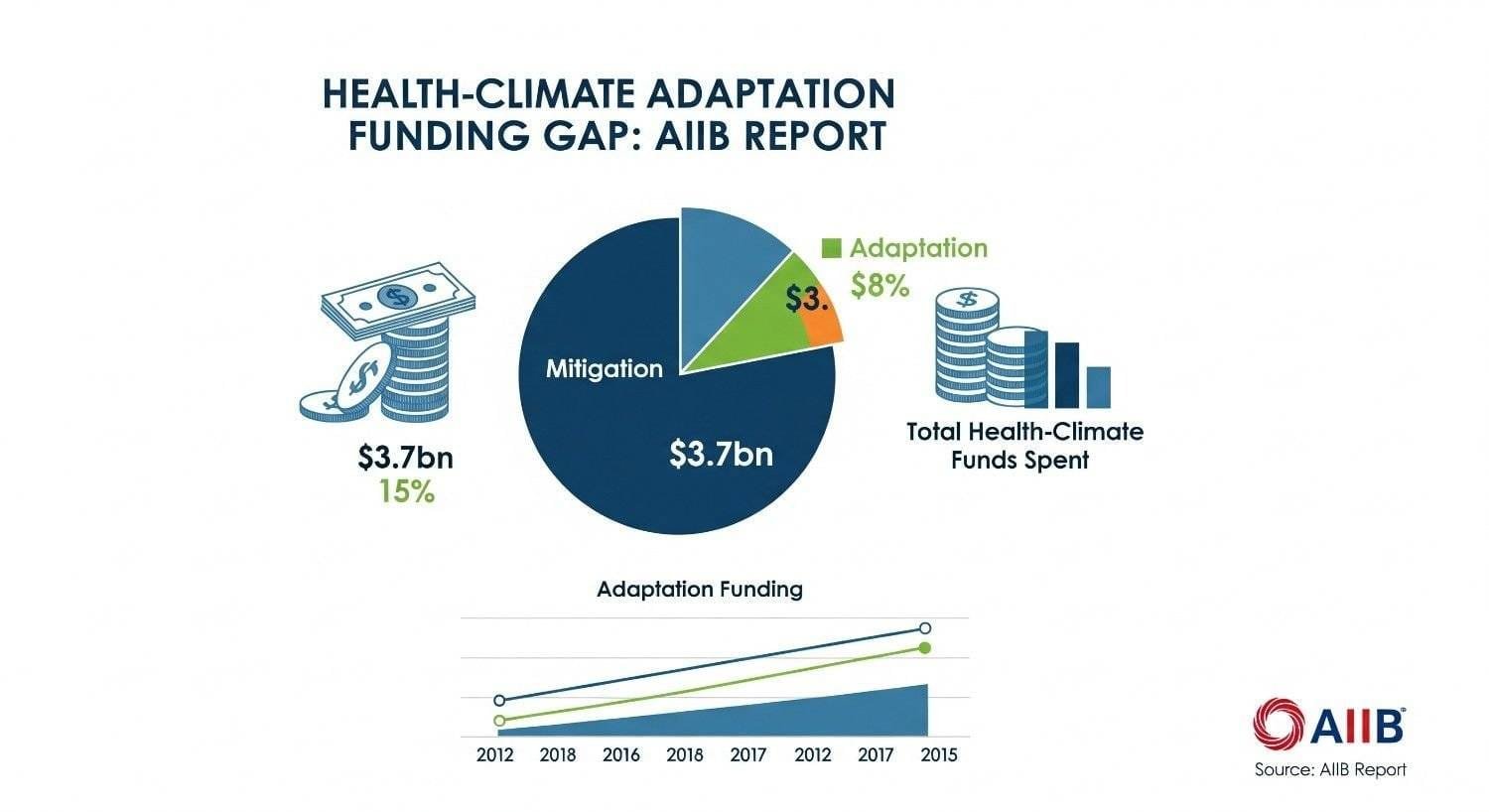
AIIB Report Highlights Adaptation Gap in Health-Climate Funds
Health-climate funds, crucial for safeguarding global well-being, saw a significant disparity in allocation towards adaptation efforts, according to a recent report by the Asian Infrastructure Investment Bank (AIIB). The report, titled “Protecting Our Future: An Investment Framework for Quantifying the Climate Adaptation Benefits of Health and Immunisation Investments,” reveals that despite major funders committing $42.2 billion to health and climate initiatives between 2019 and 2023, only $3.7 billion was specifically directed towards climate adaptation.
Multilateral development banks (MDBs), including AIIB, the World Bank, and Gavi, collectively invested nearly $2 billion during this period to bolster health systems against climate change impacts. However, the report underscores a critical gap, noting that less than 0.5 percent of global climate finance currently supports human health interventions aimed at adaptation.
Understanding Health-Climate Funds for Adaptation
The study proposes a quantitative framework to help funders and governments identify health sector investments that concurrently advance both health and climate objectives. Interventions such as strengthening healthcare infrastructure, improving early warning systems, and enhancing immunisation delivery and cold-chain systems offer substantial climate adaptation values. For instance, for every $100 invested in these activities, up to $36.50 contributes to mitigating the additional disease burden caused by a changing climate.
Regional Focus: Pakistan’s Health-Climate Funds Allocation
The report examined health-sector investments in six climate-vulnerable nations: Pakistan, Bangladesh, Ethiopia, Malawi, Nigeria, and the Philippines. It found an encouraging trend of increasing funding for health programs with climate adaptation objectives in these regions. SindhNews.com recently highlighted the urgency of such investments at a local level.
In Pakistan, a country highly susceptible to extreme climate events like floods and heatwaves, overall climate finance from 2019 to 2021 reached an estimated $5.4 billion. However, a significant portion (74 percent) of this funding targeted mitigation efforts, with only a quarter, or $1.37 billion, allocated to adaptation activities. This imbalance reflects pressing domestic priorities, such as poverty eradication, often overshadowing long-term climate resilience.
Climate-related health hazards in Pakistan primarily stem from extreme heat, erratic rainfall patterns, landslides, and droughts, events that have intensified in frequency in recent years. Communities along the Indus River, in particular, face heightened risks of diseases like cholera and malaria due to frequent flooding. These findings reiterate the urgent need for more dedicated health-climate funds toward adaptation strategies.
Conclusion
The AIIB report clearly identifies a substantial funding gap in climate adaptation within the health sector. While overall investments in health and climate initiatives are significant, the limited allocation towards adaptation leaves vulnerable populations exposed to escalating climate-driven health threats. Addressing this disparity through targeted and strategic investment of health-climate funds into resilient health systems remains a critical global imperative.