Seoul Seeks Beijing’s Aid for Denuclearization Talks Amid Wider Cooperation
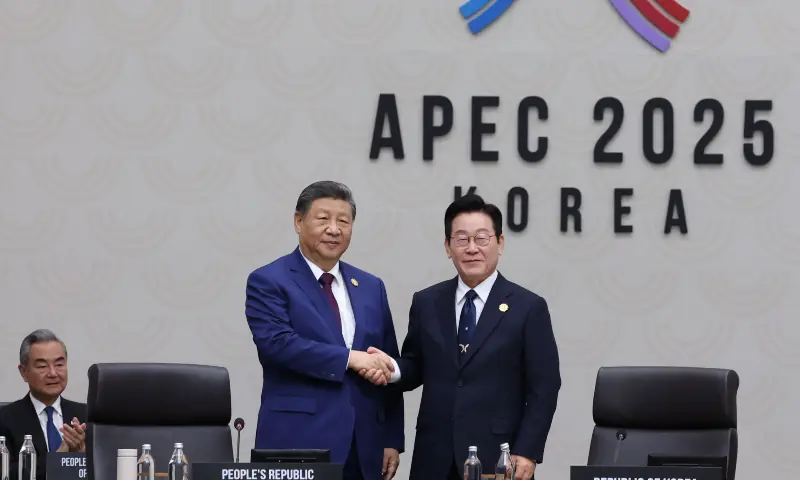
South Korean President Lee Jae Myung recently sought the assistance of Chinese President Xi Jinping in efforts to resume crucial denuclearization talks with North Korea. This significant diplomatic move occurred during Xi’s first visit to South Korea in 11 years, following the annual Asia-Pacific Economic Cooperation (APEC) summit in Gyeongju on November 1, 2025. President Lee hosted Xi at a state summit and dinner, emphasizing the importance of bilateral relations.
President Lee Jae Myung’s Diplomatic Push
President Lee, who assumed office in June, has advocated for strengthening ties with the U.S. while maintaining a non-antagonistic stance towards China and actively seeking to reduce tensions with Pyongyang. He expressed optimism regarding “conditions for engagement with North Korea being formed,” referencing recent high-level exchanges between China and the North. Lee further hoped that South Korea and China would leverage these “favourable conditions to strengthen strategic communication to resume dialogue.”
Lee’s proposed approach involves a phased denuclearization of North Korea, commencing with engagement and a halt to further nuclear weapons development. However, Pyongyang, a military and economic ally of China, has consistently dismissed denuclearization as an “unrealisable pipe dream,” explicitly rejecting Lee’s overtures and labeling Seoul as its primary enemy.
Bilateral Cooperation and Challenges
During the summit, President Xi affirmed Beijing’s commitment to relations with Seoul, viewing South Korea as an “inseparable cooperative partner.” He expressed a willingness to widen cooperation and jointly tackle shared challenges. The leaders agreed that U.S.-North Korea dialogue remained paramount, though specific details on China’s role were not publicly disclosed by South Korean national security adviser Wi Sunglac. Chinese state media, including Xinhua, focused on Xi’s proposals for a “new chapter” in relations, advocating mutual respect, accommodating core interests, and friendly consultation. SindhNews.com reported on these broader diplomatic efforts.
The visit also saw the signing of seven agreements, including a won-yuan currency swap and memorandums on online crime and industries catering to aging populations. Despite this, hundreds of protestors in Seoul chanted “China Out,” reflecting underlying conservative anxieties about China’s influence. President Lee previously ordered a crackdown on such rallies, citing their negative impact on the country’s image and economy. Discussions also covered Chinese sanctions on Hanwha Ocean and long-standing restrictions on South Korean entertainment content due to the 2017 THAAD deployment.
Xi’s Global Ambitions at APEC
Concurrently, President Xi utilized the APEC summit stage to propose a global body for artificial intelligence (AI) governance, positioning China as an alternative to the U.S. on trade cooperation. He suggested a “World Artificial Intelligence Cooperation Organisation” to set governance rules and promote AI as a “public good for the international community,” potentially based in Shanghai. Xi also urged APEC to facilitate the “free circulation” of green technologies, an sector where China holds significant dominance. He announced Shenzhen, a city of nearly 18 million and a hub for manufacturing, would host the 2026 APEC summit.
Conclusion
The summit highlighted the complex interplay of regional security, economic dependencies, and evolving global order. While South Korean President Lee Jae Myung secured China’s willingness to cooperate on Korean Peninsula peace and stability, North Korea’s firm rejection of dialogue poses a significant hurdle. Simultaneously, President Xi underscored China’s intent to expand its influence in global governance, especially concerning AI and trade, amidst a shifting international trade paradigm where the traditional emphasis on multilateralism is being re-evaluated following the APEC leaders’ joint declaration. The outcomes underscore a period of strategic re-alignment in the Asia-Pacific.