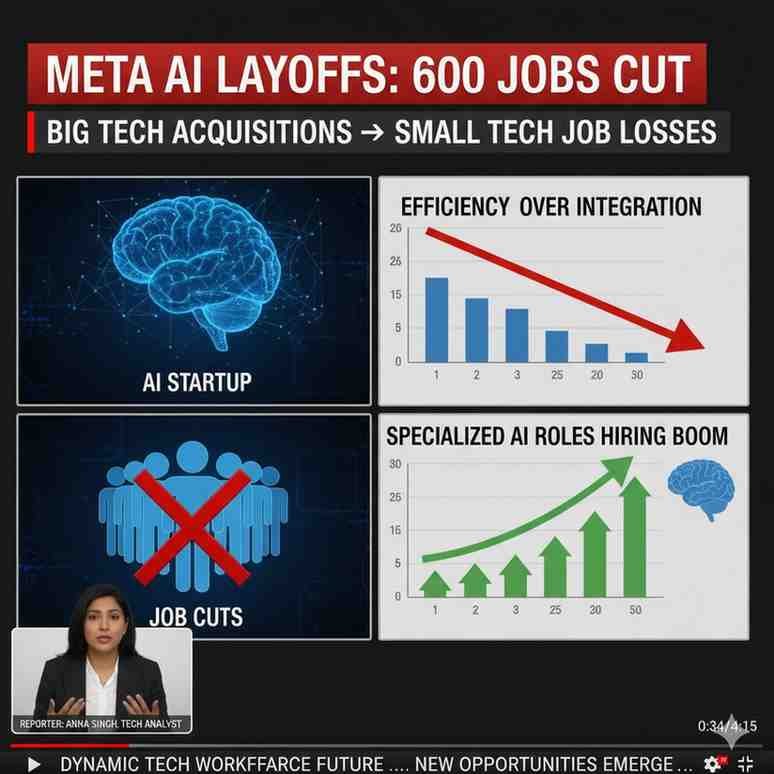
Meta AI layoffs have once again brought to the forefront a critical discussion about the stability of careers in the rapidly evolving artificial intelligence sector. Recently, Meta announced the layoff of approximately 600 employees within its artificial intelligence unit, marking the latest instance of a trend where significant AI valuations and acquisitions are increasingly accompanied by workforce reductions. This development underscores a growing sentiment among industry professionals that the hottest career path in tech may now carry more risk than initially perceived riches.
Traditionally, joining a nimble startup in an emerging field like AI offered the promise of growth alongside new technology and the potential for substantial benefits upon acquisition by a larger entity. However, this perspective is shifting, with many employees now viewing such opportunities with an increased sense of risk.
The Evolving Landscape of AI Acquisitions and Layoffs
The pattern of job cuts following significant investments or acquisitions in AI startups is becoming increasingly evident. Digitalvision data, corroborated by Getty Images, points to several high-profile examples. Around the same time Accenture declared its investment in data labeling startup Snorkel AI in August to bolster its financial services clients, Snorkel AI concurrently announced the layoff of about 13% of its staff. This was not an isolated incident.
Similarly, when Meta acquired a substantial stake in Scale AI in June, the deal was widely considered a vote of confidence in the fast-growing data-labeling firm. Yet, it also acted as the catalyst for the layoff of 14% of Scale AI’s workforce. The trend continued with Windsurf, a coding AI startup, which offered buyouts to all its employees after a failed acquisition attempt by OpenAI. Later, when Cognition acquired the company, it laid off 30 staffers and again offered buyouts, according to reports from The Information.
Even seemingly positive acquisitions have dual outcomes. HP’s acquisition of the AI pin company Humane, for instance, led to some staffers receiving pay increases ranging from 30% to 70%, as revealed by Techcrunch. However, others experienced immediate layoffs, demonstrating the mixed reality of these transitions. The recent 600 Meta AI layoffs, announced by Meta’s Chief AI Officer Alexandr Wang in an internal memo, further solidify this emerging pattern. Wang, who is also the founder of Scale AI, communicated these decisions as part of ongoing strategic adjustments.
Why These AI Layoffs Feel Different
While job losses after corporate mergers are not unprecedented, the nature of these AI-driven acquisitions presents a distinct scenario. A significant factor contributing to this disruption is that large technology firms are still recalibrating their workforces following years of extensive hiring during the pandemic era. When Big Tech companies like Meta double down on artificial intelligence by acquiring or investing in agile startups, the workforces of those smaller companies are often the first to feel the impact, driven by a focus on efficiency.
“In the past, there would have been more concessions made to culture, to continuity, to that sort of thing,” stated JP Gownder, Forrester vice president and principal analyst. “That’s just not where we are. Big Tech is all about cutting to the very minimum viable staff for a variety of reasons.” This new emphasis on Wall Street scrutiny over nurturing startup culture often results in the swift elimination of duplicate functions. Accenture, Meta, Cognition, and HP did not respond to requests for comment regarding these trends.
Malinda Gentry, EY-Parthenon Americas leader for the Technology, Media and Telecommunications (TMT) industry, explained, “As these big tech companies continue to pivot towards growth and that growth is generally driven by AI, they are going to shed lower growth or non-core assets, whether they divest them, they wind them down, or they restructure them.” She added, “That is going to result in needing less of that workforce or creating a more streamlined and efficient workforce.” The rapid pace of AI development is undeniably a primary driver of these workforce adjustments.
The Impact on AI Talent and Career Paths
The World Economic Forum estimates that AI could eliminate approximately 80 to 85 million jobs worldwide over the next three years, while simultaneously creating as many as 170 million new ones. This presents a formidable challenge for tech workers: securing a place in the evolving landscape as the industry shifts towards a more AI-enabled workforce. Startup roles, once seen as stepping stones for substantial career growth and acquisition windfalls, now carry significant job volatility. SindhNews.com reports highlight local concerns about similar transformations.
Startups are less likely to be preserved as standalone units following acquisition and are increasingly streamlined into the acquiring Big Tech company’s existing operations. This shift occurs within a labor market where job seekers have largely lost the “job hopping” edge prevalent during the COVID era. Gownder noted, “When you buy a company, if you get rid of people who are at the company – unless you bought it purely for the IP or for the customer – you don’t really want to get rid of the talent in general. But it is such an employer’s market at the moment, what are people going to do?”
The swift advancement of AI also contributes to workforce churn by prompting many tech companies to not only anticipate needing fewer entry-level positions but also to fundamentally rethink their employee structures, placing a greater emphasis on senior roles. Many organizations are moving towards a “flatter organizational model,” according to Gownder, leading to “a lot of the layoffs happen[ing] at that middle management layer.” This is fundamentally a bet on technology and streamlined product development cycles reducing the need for extensive management layers.
Navigating the New Reality and Beyond
The uncertainty surrounding AI startup acquisitions could fundamentally alter recruitment practices. Future contracts may begin to include stronger guarantees of equity or severance packages in the event of an acquisition, as workers grow increasingly wary of being left behind. Gownder expressed concern that “the implication of this ‘buy and liquidate the staff’ is sort of troubling,” potentially making it “a little harder for some of these startups to hire the talent that they want, if the talent that they want is hoping to have a share in the spoils of this.”
Despite the turbulence characterized by the widespread Meta AI layoffs and those across the industry, experts emphasize that job cuts do not tell the entire story. For every downsizing announcement, there are also significant hiring pushes in areas directly tied to AI strategy, such as machine learning, data science, and AI safety. Big Tech remains in a fierce race to secure scarce talent in these highly specialized fields. The future of a largely AI-powered tech workforce is an undeniable reality.
As Gentry concludes, “There’s going to continue to be a trend in workforce reduction. But that is balanced with the ability to continue to grow and acquire talent, whether that talent is hired, acquired, or partnered with in the ecosystem.” This suggests a dynamic environment where adaptation and skill specialization will be key for tech professionals.
Conclusion
The recent Meta AI layoffs serve as a stark reminder of the volatile yet transformative impact of artificial intelligence on the tech economy. While AI promises unprecedented innovation and the creation of entirely new job categories, its integration into existing corporate structures often leads to significant workforce reconfigurations and displacement, particularly within acquired startups. The current landscape necessitates a strategic shift for both companies and employees, focusing on continuous skill development, adaptable organizational models, and potentially revised contractual agreements to navigate the dual forces of disruption and opportunity presented by the AI revolution.
Summary:
The latest Meta AI layoffs, impacting 600 employees, highlight an unsettling trend where Big Tech’s AI acquisitions often trigger significant job cuts in smaller companies. Once seen as career engines, AI startups are now perceived as riskier as larger firms prioritize efficiency over cultural integration. While job losses are a reality, this transformation also sparks intense hiring in specialized AI domains, signaling a dynamic, reconfigured tech workforce future.