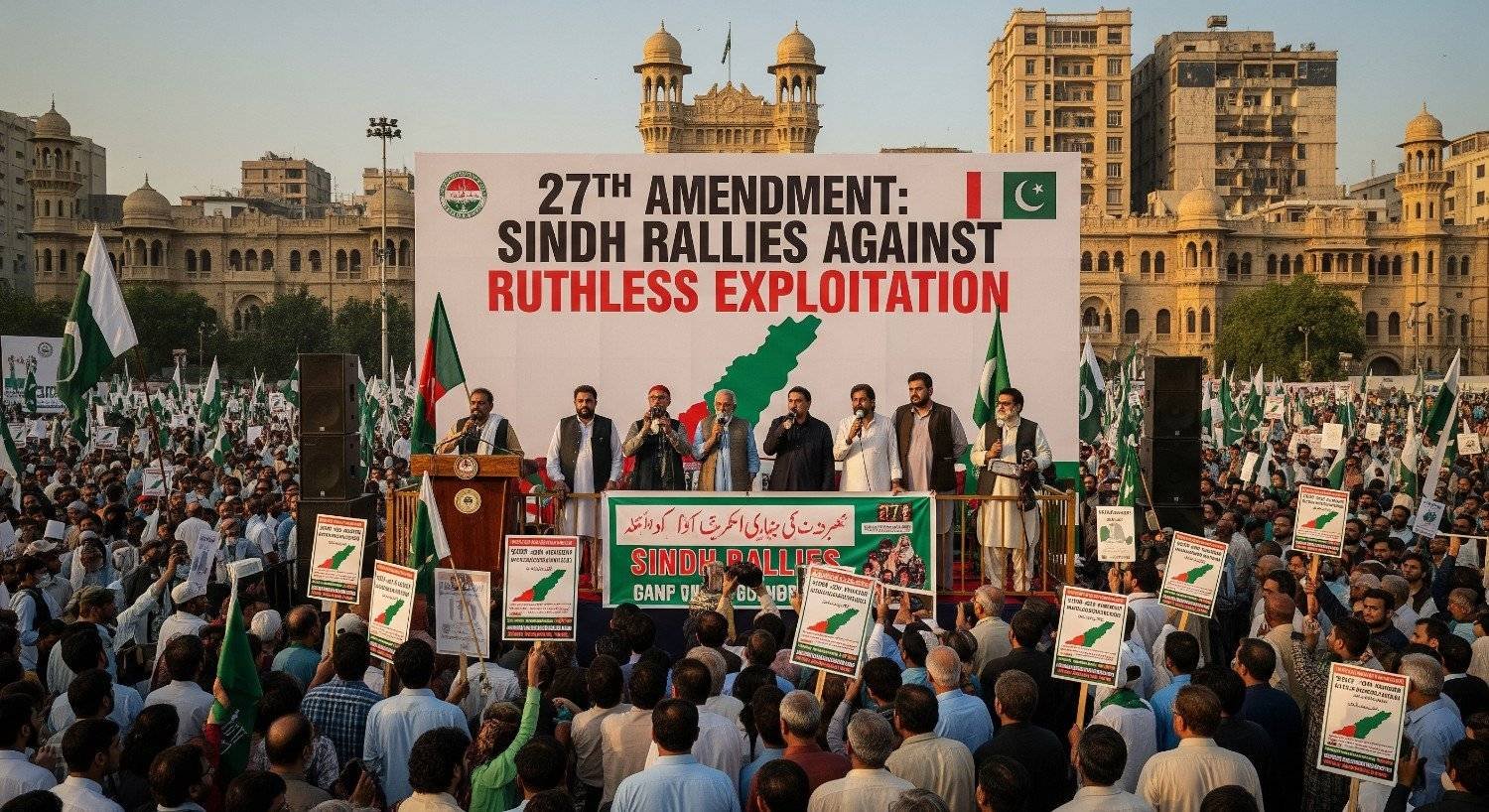
Awami Tehreek Mobilizes Against Constitutional Amendments and Resource Exploitation in Sindh
Awami Tehreek stages rally in Hyderabad, alongside its women’s wing, Sindhiyani Tehreek, protesting the controversial 27th Amendment, the proliferation of corporate farming, and the alleged exploitation of Sindh’s vital resources. The demonstration on Sunday highlighted deep concerns over new canal projects on the Indus River, as well as societal issues like so-called honour killings.
The substantial march commenced from Jail Road, drawing a large number of activists and concluding at the local press club. Here, party leaders addressed the gathering, articulating their grievances. The rally was prominently led by Awami Tehreek President Vasand Thari, accompanied by Noor Ahmed Katiar, Lal Jarwar, and Dr. Rasool Bux Khaskheli, among others. Noted writer Jami Chandio and other legal representatives from Hyderabad and Mirpurkhas also participated.
Awami Tehreek’s Stance on the 27th Amendment
Vasand Thari sharply criticized the 27th Amendment, labeling it “worse than the post-hybrid system and an attack on democracy.” He asserted that the amendment distorts the Constitution, suppresses fundamental rights, and undermines the judiciary, thereby enabling unchecked exploitation of Sindh’s rich mineral and other resources. This perspective resonates with many seeking greater provincial autonomy, as reported by SindhNews.com.
Mr. Thari further condemned the Special Investment Facilitation Council (SIFC), viewing its creation as a mechanism to divest the province of its lands, minerals, and other assets. He equated corporate farming with a “conspiracy to occupy the lands of the oppressed,” highlighting concerns that millions of acres are being allocated to companies. He pledged strong resistance against any attempts to divide Sindh or seize its water resources through projects like the Kalabagh Dam, Bhasha Dam, and proposed six new canals, which he termed a concerted conspiracy.
Umra Samoon, President of Sindhiyani Tehreek, echoed these sentiments, particularly criticizing the SIFC, which she linked to the support of the Pakistan Peoples Party (PPP). She further stated that the 27th Amendment transformed a judiciary already weakened by the 26th Amendment into a “government court,” consolidating executive power.
The rally concluded with the adoption of several resolutions. These condemned the alleged distortion of the Constitution and the suspension of fundamental rights, leading to what they termed a “constitutional dictatorship.” The resolutions specifically denounced the lifetime immunity granted to the president and Field Marshal under the 27th Amendment, claiming it elevated them above the state and its 250 million citizens, effectively enforcing a monarchy. They demanded that the Constitution be realigned with the principles of the Pakistan Resolution of 1940.
The Awami Tehreek also condemned a recent attack on a lawyers’ convention in Sukkur, attributing it to opposing the 26th and 27th Amendments, and termed it an act of terror. The resolutions underscored that the Indus River is fundamental to Sindh’s civilisational identity and lifeline, demanding an immediate halt to all dam and canal projects envisioned for it. Furthermore, they called for the revocation of the Prevention of Electronic Crimes Act and amendments to the Anti-Terrorism Act, alongside the withdrawal of the Mines and Minerals Amendment Bill 2025, advocating for powers to remain firmly with the provinces.
In conclusion, the Awami Tehreek’s rally demonstrated a significant mobilization of public opinion against judicial overreach, environmental concerns, and the perceived infringement on provincial autonomy. The protest highlighted a broad range of grievances, signaling ongoing resistance to policies and amendments perceived as detrimental to Sindh’s heritage and future.